There are applications that we consult almost without realizing it. We do it as soon as we wake up, before leaving the house, while we are organizing a trip or when we simply want to understand if the heat will give us a break. Among these, the weather occupies a special place. It’s probably one of the few pieces of information we check every day, often several times within a twenty-four hour period, as if knowing the temperature or the probability of rain could offer us the illusion of having greater control over the weather ahead.
Yet, observing that succession of numbers, icons and graphs, we rarely focus on an aspect as obvious as it is overlooked: the sky is not just a meteorological data. It’s a visual experience. It has a different light every morning, changes color throughout the day, changes the perception of cities, landscapes and even our mood. A summer afternoon at 30 degrees on the Mediterranean coast does not convey the same sensation as a day with the same temperature in the center of a large metropolis suffocated by humidity. The numbers are identical, but what we experience is completely different.
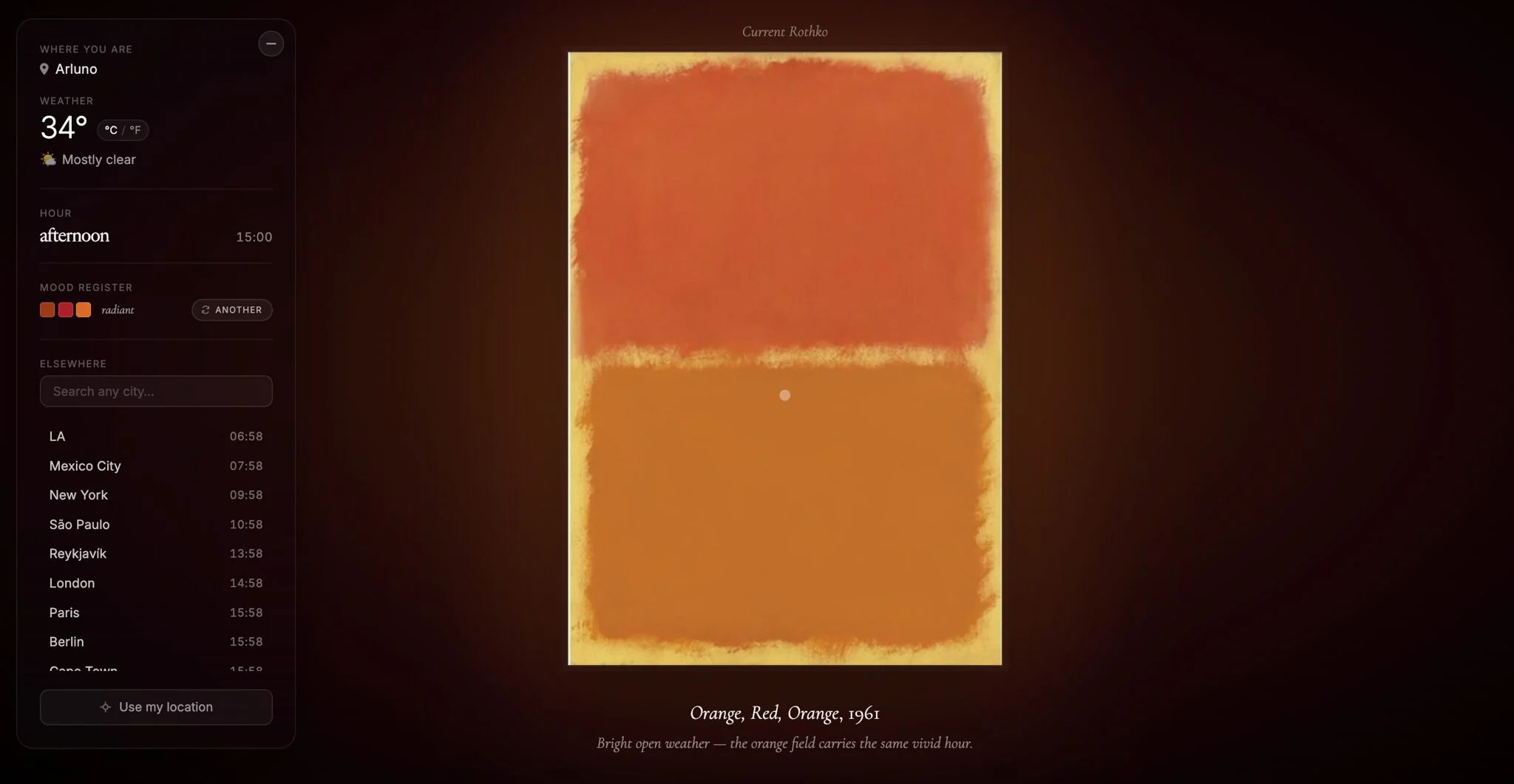
It is precisely from this reflection that it was born Current Rothkothe project created by the Finnish designer and creative director Joonas Virtanenwho decided to replace traditional weather forecasts with something seemingly very far from meteorology: a painting by Mark Rothko. By entering the name of a city, the site not only returns temperature, atmospheric conditions and local time, but also identifies the work of the American artist that best represents the atmosphere of that precise moment, transforming the weather into an aesthetic experience.
From meteorology to emotion
The idea may seem like a game, but behind its apparent lightness lies a surprisingly profound reflection on the relationship between data and perception.
«The weather forecast tells you the temperature and whether you need to bring an umbrella, but I’m interested in translating all this into what that day makes you feel», explained Virtanen when presenting the project. “Weather is made of data, but it is also a shared experience, and these two things rarely coincide.”
It’s a radical change of perspective. For decades, technology has tried to make forecasts increasingly accurate, increasing the amount of data available and the precision of mathematical models. Current Rothko, on the other hand, takes the opposite path: it does not add information, but tries to restore an emotional dimension to something that we are now used to reading exclusively through numbers and percentages.
The objective, in fact, is not to predict the weather better, but rather to describe its perceptive quality. What does that day look like? What atmosphere does it convey? Which colors seem to dominate it? These are questions that a traditional algorithm doesn’t even try to answer.
Why Mark Rothko?
The choice of the artist is not at all random. If there is a painter who made color the main language of emotions, it is Mark Rothko.
Among the protagonists ofAbstract expressionism and of the so-called Color Field PaintingRothko progressively abandoned any figurative reference to concentrate on large suspended chromatic fields, capable of evoking moods rather than describing objects or landscapes.
The artist himself rejected the idea that his paintings were simple abstract compositions. He said he painted fundamental emotions such as tragedy, ecstasy, joy and destiny, and asked museums to exhibit his works in intimate environments, with soft lighting and at a lower height than normal, so that the visitor could almost enter inside. His canvases, he argued, were not simply to be observed, but experienced.
From this point of view, the sky represents almost the natural extension of his research. Even the sky, in fact, communicates through color. Even the sky changes continuously while remaining apparently identical. Even the sky, like a Rothko, can be reassuring, disturbing, melancholy or bright without telling anything concrete.
How the algorithm works
Behind the simplicity of the interface lies a much more sophisticated work than you might imagine.
Current Rothko collects meteorological data relating to the chosen location — temperature, time of day, sunrise, sunset, cloud cover, rain, fog and thunderstorms — and translates it into what Virtanen defines as a true “emotional register”. Each painting in the archive has been manually cataloged according to brightness, color temperature, palette and emotional atmosphere. The algorithm then compares these parameters with those of the day and assigns a score to each work, selecting the one that best represents the moment experienced by the user.
The database currently includes 89 paintings by Rothko, chosen from those available through WikiArt and other sources that allow use compatible with the limitations imposed by the copyright still in force on the artist’s work. Virtanen explained that the most complex aspect was not developing the code, but finding a balance so that the pairings were “emotionally correct” and not simply mathematically consistent.
When artificial intelligence stops imitating artists
Perhaps the most interesting aspect of the project concerns the way in which it uses technology.
In recent years we have become accustomed to talking about artificial intelligence almost exclusively as a tool capable of producing images, imitating pictorial styles and generating new works. Current Rothko instead chooses an opposite direction. He does not create a fake Rothko, he does not try to replace the artist and he does not use generative models to produce new canvases. It does something much more discreet: it uses an algorithm to bring attention back to the original work.
It’s a substantial difference. Instead of multiplying synthetic images, the project invites the user to rediscover an already existing artistic heritage, demonstrating that technology can also become a tool of cultural mediation, capable of creating unexpected connections between our everyday life and the history of art.
From the sky to the museums
It is no coincidence that Current Rothko is attracting attention just as the debate grows on how museums and cultural institutions can use algorithms and digital tools not to replace the experience of visiting, but to make it more accessible and engaging.
In this sense, Virtanen’s project tells of a broader trend. Algorithms are progressively no longer limiting themselves to suggesting what to buy, which film to watch or which restaurant to choose. More and more often they become cultural mediators, capable of building personalized paths between works, collections and artists.
Current Rothko represents perhaps one of the most poetic examples of this transformation. Because it takes one of the most automatic gestures of our day – checking the weather – and transforms it into an opportunity to meet one of the great protagonists of twentieth century art.
And in an era in which climate change forces us to observe the sky with growing concern, there is something surprisingly reassuring in the idea that, at least for a few moments, those same clouds can be told not by a graph, but by a painting by Mark Rothko.